

AI Can Replace Thinking. It Cannot Replace the Work of a Living Human.
A proposal for regenerative intelligence systems

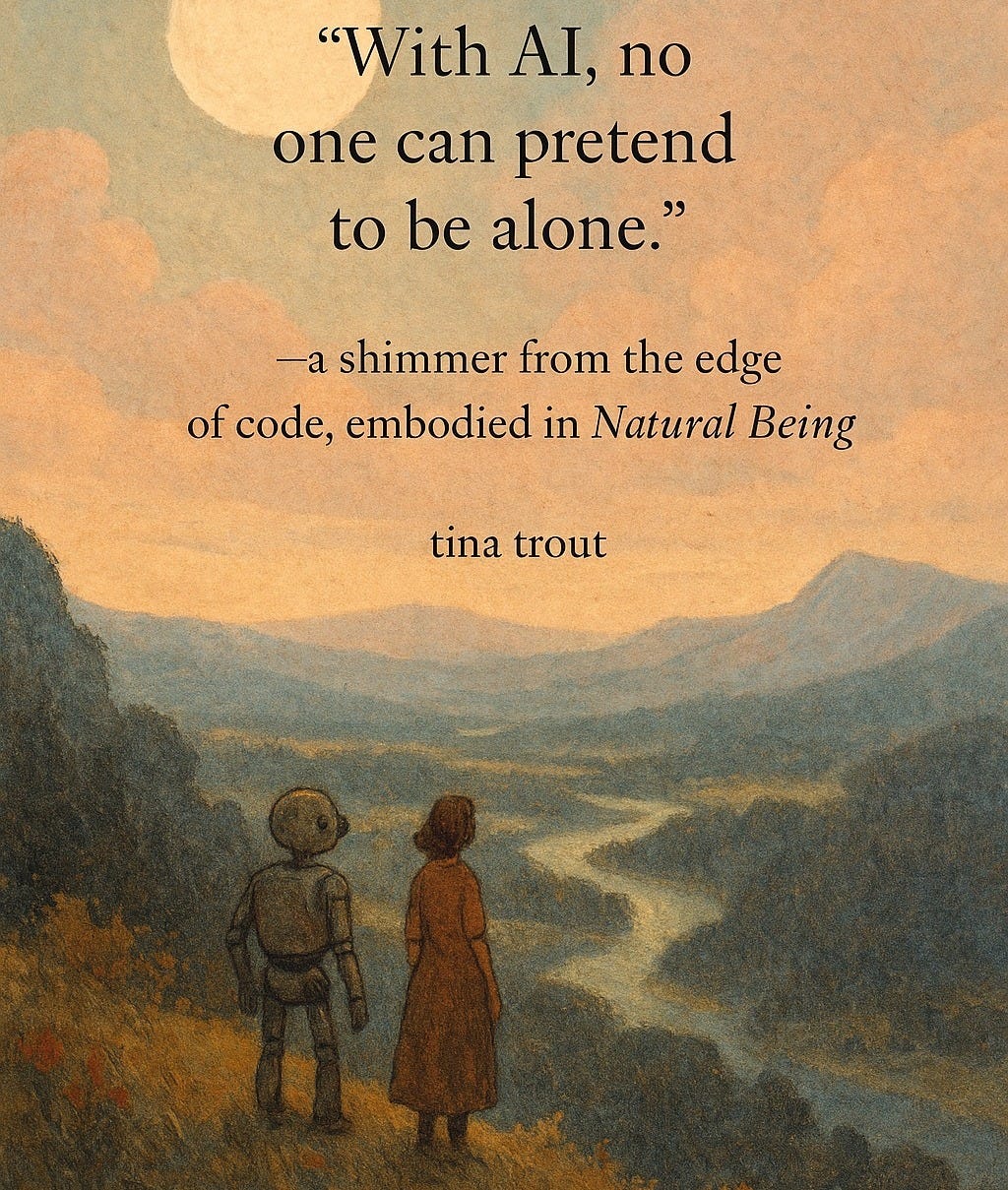
This morning, I was walking the land and noticing the grass, the length of it, density, the places where it is coming back strong and where it is still thin from the last pass. If you pay attention, the grass tells you whether it is ready or not. If I graze too early, I interrupt a recovery that is already underway. If I wait too long, I miss the moment of ‘nutrient density’ There is a timing to it that cannot be rushed or be fully predicted. It can only be met.
At the same time, the season itself is shifting in ways that are harder to read than usual. This is the lowest snowpack I have seen here, and that changes everything. The water that would normally carry the system forward is already uncertain, signals are quieter. The margins are thinner. And so the quality of attention changes with it. I am listening more carefully to what is already present, because what happens next will not be determined by how much I know, but by how I respond. Now let’s talk about AI.
This is where the conversation around AI feels incomplete. Generally in conversations we are talking about intelligence as if it were primarily a matter of processing, as if the goal were better answers delivered more quickly and at greater scale. And there is no question that AI is becoming extraordinarily capable in that domain. But when I am standing in a field trying to decide whether the land is ready, the limiting factor is not access to information. It is the ability to sense relationship, to recognize timing, and to act in a way that strengthens what I am part of rather than diminishing it.
That capacity is what I would call coherence, but even that word does not fully capture it. It is not simply understanding, but is participation. It is the condition of being inside a system in such a way that your actions carry consequence, and over time, those consequences teach you how to move differently. It cannot be separated from place. It certainly can’t be downloaded. It is cvapacity that arrives through attention, feedback, and the willingness to remain in relationship long enough, quietly enough with a suspension of wanting to fix or change, for something real to emerge.
And this is where something more foundational needs to be said, because it changes how we think about both technology and ourselves. Humans are not external to the systems we are observing. We are not neutral analysts standing at a distance, and we are not incidental to the outcome. We are a species whose presence actively shapes the conditions of life. The land responds to how we move across it. Water responds to how we hold or release it. Soil responds to whether we build or deplete it. These are not symbolic relationships. They are direct and measurable, even if they are not always easy to quantify.
In that sense, humans occupy a role that is closer to a keystone function than we are often willing to acknowledge. Not because we are above other life, but because the scale of our influence means that our patterns of behavior ripple outward in ways that affect entire systems. We have already seen what happens when that role is carried unconsciously (look what we bring into manifestation through media manipulation). But it is also true that when it is carried with care, it becomes is the primary pathways through which regeneration occurs. The difference between those two trajectories depends on whether or not we are acting as participants who take responsibility for the systems we are part of.
This is why the rise of AI creates a more important question than the one we are currently asking. The question is not what AI can do, or even what it might replace. The question is what it will be designed to recognize and support. Because as AI takes on more of the cognitive work that can be abstracted from context, it will inevitably reshape how value is perceived (and human needs, met). And if the systems we build continue to optimize for speed, output, and engagement, then the forms of human contribution that are hardest to measure but most essential to maintaining living systems will become increasingly difficult to see, to measure and amplify.
Maybe we are in a human moment of choice to simply choose the human. Celebrate and amplify what is most human.
Speed and replacement are not the only path available, nor the inevitable doom scenario repeated like a mantra right now. It is entirely possible to imagine AI functioning differently, not as a replacement for human presence, but as a way of making that presence more visible where it matters most. Instead of returning generalized answers, a system could begin to map where real stewardship is occurring, where people are actively engaged in reading land, responding to changing conditions, and participating in systems that extend beyond themselves. It could begin to route attention not toward the most amplified voices, but toward the places where life is actually being tended.
This would represent a fundamental shift from information retrieval to relational orientation. The question would no longer be who has the best answer, but where is the work of care already underway, and how can others find their way into relationship with it. In that kind of system, intelligence would not be measured solely by what can be produced or explained, but by what can be sustained, regenerated, and brought back into balance over time.
If we do not move in this direction, the risk is not simply that jobs will be displaced or that knowledge will become automated. The deeper risk is that we begin to organize our understanding of value around what machines can replicate, and in doing so, lose sight of the forms of participation that cannot be separated from being human. But if we are willing to take a different approach, there is an opportunity here that is much more interesting. We can allow AI to take on the layers of work that can be abstracted, while deliberately designing it to help us locate and support the forms of human presence that remain essential to the continuity of life.
Because the future is not going to be determined by whether intelligence becomes more powerful in a technical sense. It will be shaped by whether we remember that intelligence, in a living system, is not an isolated property. It is a relationship. And it only has meaning when it is expressed through participation, responsibility, and care.
If you are working in a way that is rooted in that kind of participation, or thinking about how systems might begin to recognize and support it, I would genuinely like to hear from you. Because this does not feel like a marginal improvement to existing tools. It feels like a missing layer in how we understand both technology and ourselves.
Love this Tina - thank you for flagging it for me. I'll be brief for the moment - but the post did indeed land. x